Personalized send time
Communicate to each customer at at the moment they're most likely to engage
PESTO (Personalized Smart send Time Optimization) — Klaviyo's feature that automatically schedules each message at the optimal time for each individual recipient, rather than sending everyone at once.
Background
Most campaigns are sent at a single, fixed moment — Tuesday at 10am, everyone, all at once. It feels efficient, predictable, controlled. But behind the scenes, every customer lives on their own schedule. One checks email during their morning commute, another late at night after work. So when that 10am campaign lands, it quietly misses the moment for most people — buried under other emails before they ever get a chance to see it. Opens drop, clicks fade, and conversions slip through the cracks.
Personalized Send Time flips this: each message is delivered when that individual is most likely to engage — automatically, no guessing required. Learn more →
Solution
Personalized Send Time simplifies a once complex decision—“when should I send this?”—into a smarter system: define a window, let Klaviyo find the right moment for each person, and see exactly how much better it performs. A control group is created to continuously validate the system—giving marketers a clear, measurable way to see what changed, not just that it worked, but how much it improved performance.
How to build upon existing mental models
Designing Personalized Send Time required shifting marketers from choosing a single send time to defining a flexible window—and trusting the system to optimize within it. The challenge was making this feel intuitive, low-friction, and trustworthy.
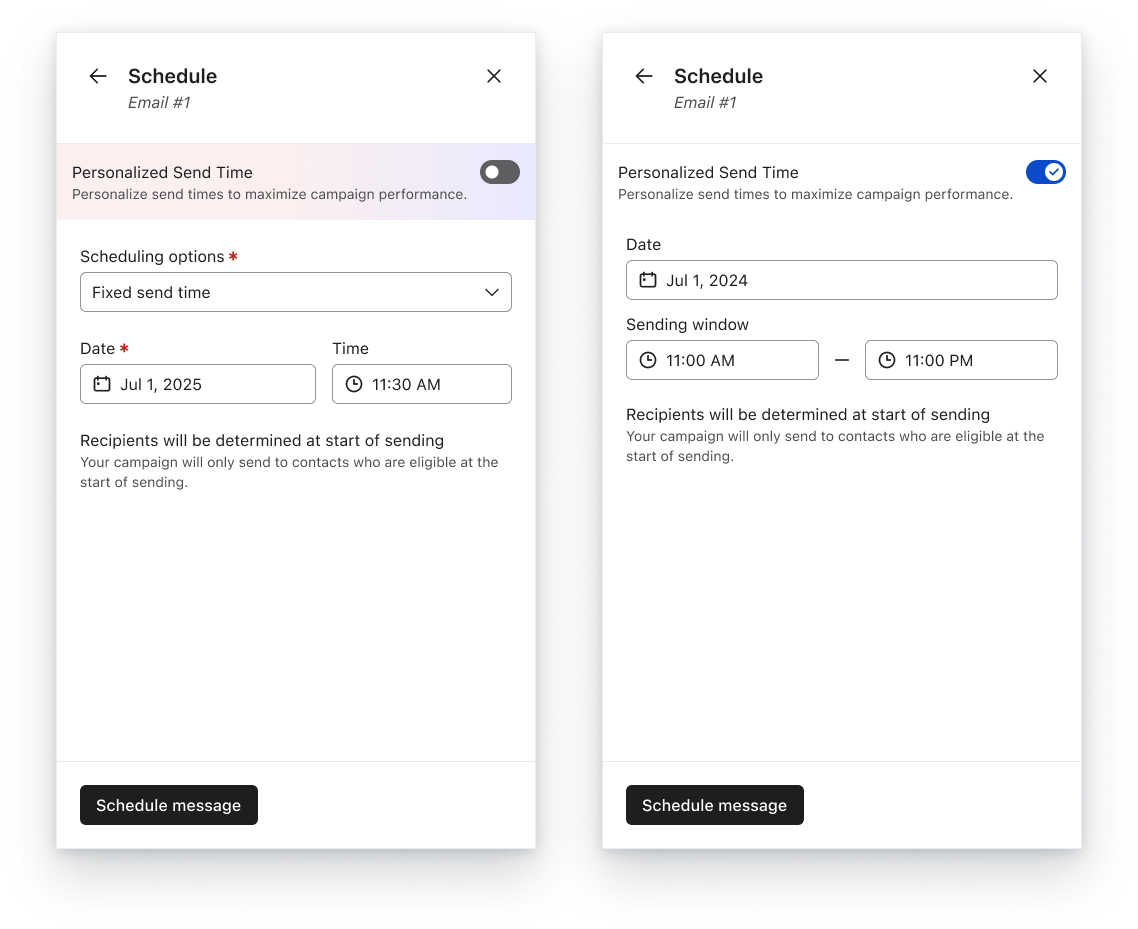
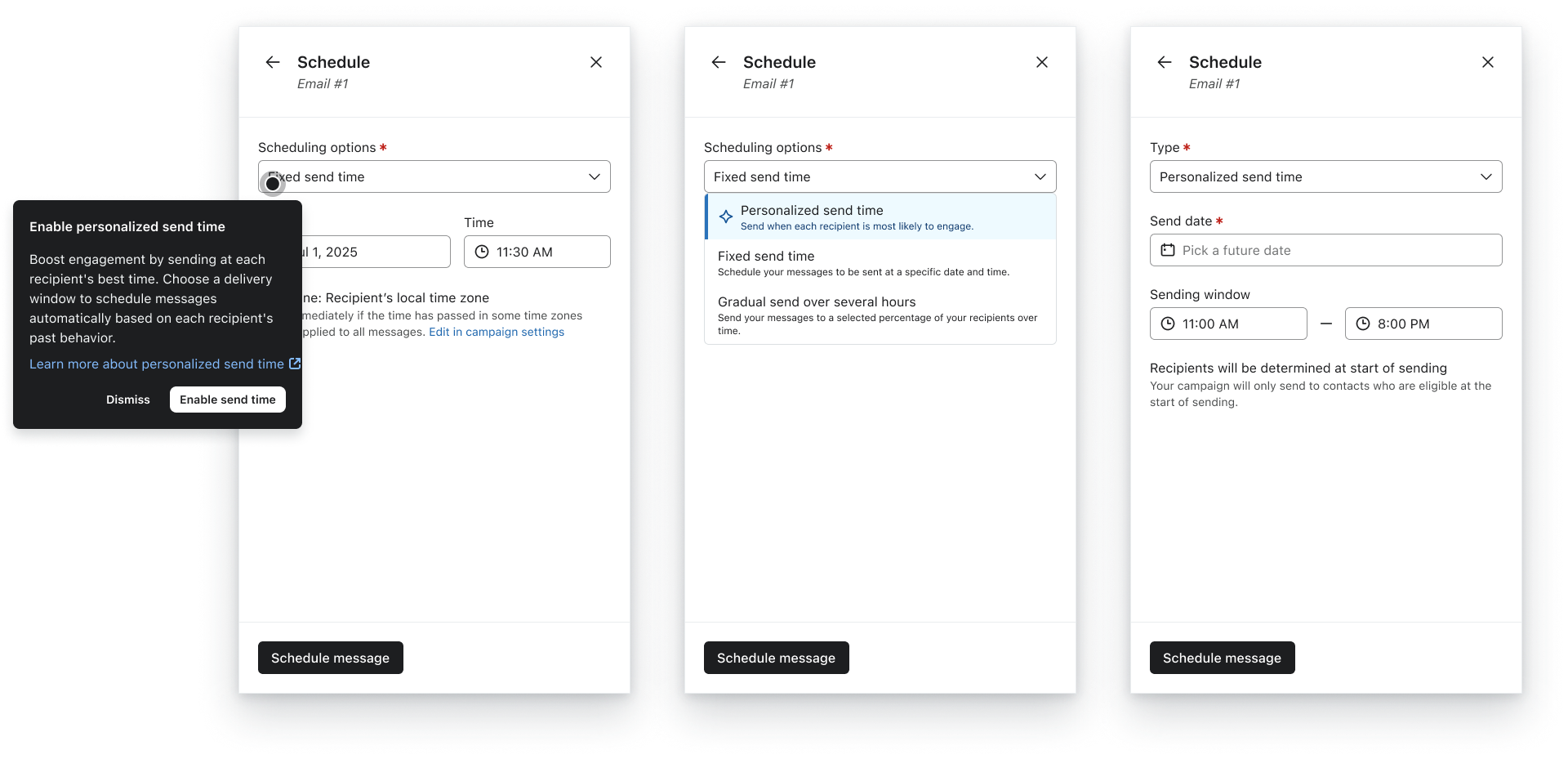
To ease that shift, I anchored the experience in familiar patterns. I tested a toggle and a dropdown, and the dropdown won—aligning with the existing “send type” selection (fixed, gradual, optimized). By building on what users already understood, it reduced cognitive load and made the new behavior feel like a natural extension of their workflow.
Toggle entry point
Dropdown entry point
How much control should I give my users?
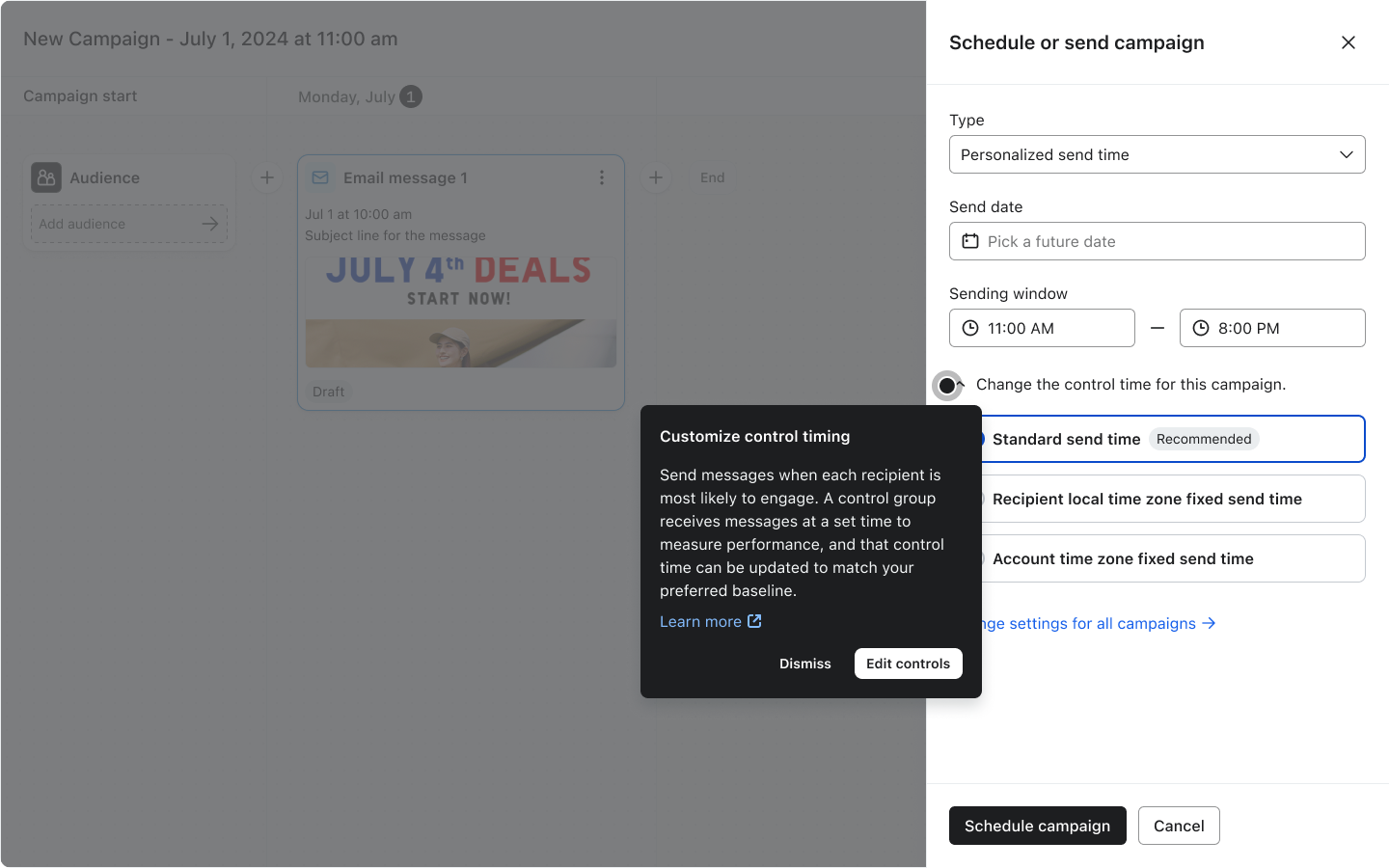
The challenge was deciding how much control to give marketers without reintroducing complexity. PST ran a silent A/B test against an invisible baseline—turning a powerful system into a black box users couldn’t trust.
I made the experiment visible at the moment of scheduling, surfacing the control baseline and introducing simple, bounded controls (a global default with optional overrides). At the same time, I preserved analytics integrity by segmenting results by baseline and locking decisions at send time.
The result shifts PST from opaque automation to a system marketers can see, understand, and trust—where “lift” is clear, measurable, and believable.
How to design for user trust
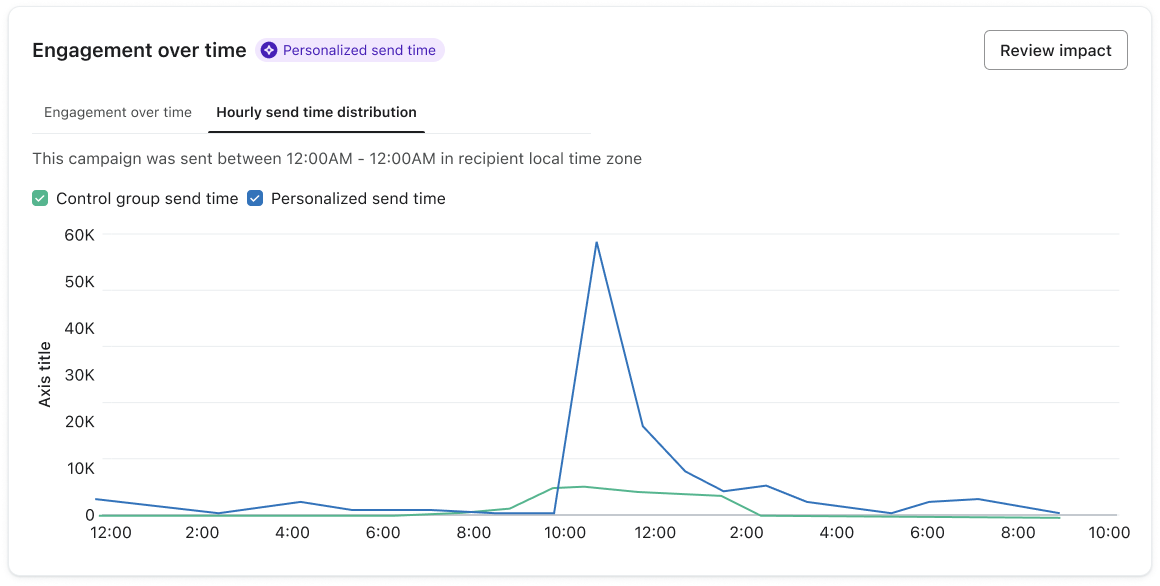
I treated analytics as a core part of the experience—not just a reporting layer—because timing optimization only works if users believe it’s working.
At the campaign level, I designed two complementary views: Engagement over time, showing when recipients actually interacted, and Send time distribution, comparing personalized sends vs. a flat control group. This dual view helps marketers connect cause (when we sent) with effect (when users engaged), making the model’s decisions legible.
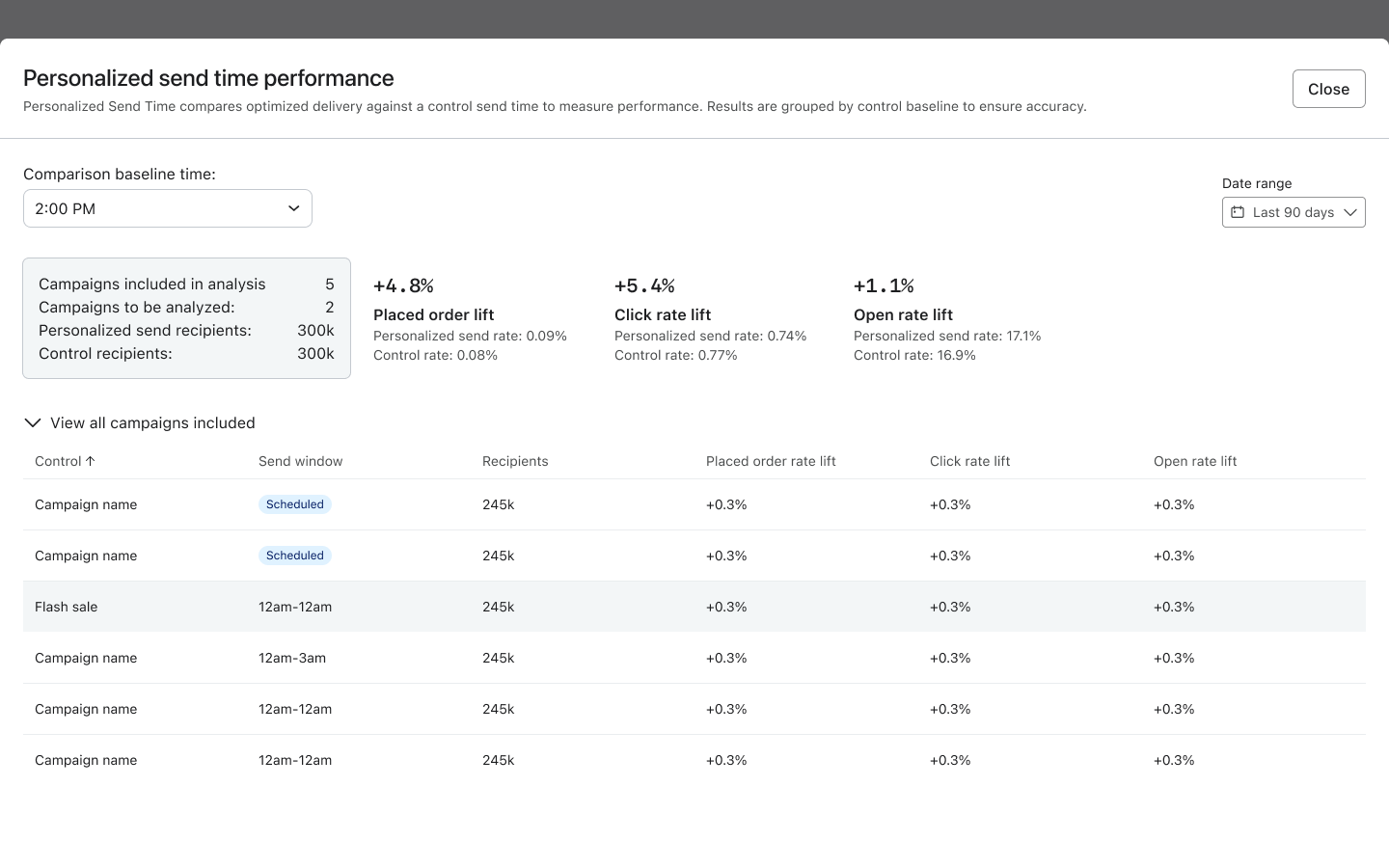
At the aggregate level, I focused on clear proof of value—headline lift metrics (orders, clicks, opens), campaign coverage, and recipient scale—so users can quickly answer: “Is this working across my account?” Together, these choices prioritize clarity over complexity, turning a black-box system into one that is measurable, explainable, and trustworthy.
Impact
Feature impact
My key design contribution:
- Simplified analytics → removed confusing metrics, improving clarity and trust
- Introduced manual control baseline, enabling measurable lift attribution
- Clarified open/click definitions (human vs. machine) to improve data accuracy
- Led post-GA research to drive adoption, trust, and repeat usage